Design & Makers··4 min read
Stunning Bocci Lighting at Heal's
A Bocci chandelier in Heal's historic stairwell, the cult 28 series and the art of hanging pendants at different heights.
Some lighting simply illuminates a room. Other lighting becomes the room. In late summer 2013 we were thrilled to hear that Bocci lighting was coming to Heal's on Tottenham Court Road, with a specially created chandelier designed to hang in the store's spiralling stairwell. For anyone who loves glass, light and a little drama, it was a perfect match.
Here is why the pairing of Bocci and Heal's felt so special, what makes the Bocci 28 series such a cult design, and how to borrow the idea of clustered pendants for your own home.
Bocci lighting at Heal's: a perfect pairing
Heal's has been part of London's design story for generations, and its Tottenham Court Road building is a pleasure to wander around in its own right. Its staircase, designed by Cecil Brewer and dating from 1916, curls up through the building, which makes it an ideal home for a hanging installation that can be viewed from every level.
Bocci, the Vancouver-based design and manufacturing company led creatively by Omer Arbel, was commissioned to create a chandelier for that space. The finished Heal's chandelier, unveiled during the London Design Festival in September 2013 alongside a new lighting showroom, was made up of dozens of glass pendants on long cables, cascading down the stairwell so that you experienced it differently from every step.
The best chandeliers are not objects you look at once. They are ones you keep walking around, looking up at and discovering again.
Omer Arbel and the Bocci 28 series
To understand why design fans got so excited, it helps to know the Bocci 28 series. Arbel numbers his projects rather than naming them, and 28 has become the best known. Each pendant is made using a complex glass-blowing process involving repeated heating and cooling, so that an inner glass form sits inside a softly irregular outer shape, with the light source suspended within.
Because of that process, no two pendants are exactly the same. Hung singly they are lovely; hung in clusters they become something closer to sculpture. Bocci's approach is modular, so the pendants can be arranged in all sorts of configurations, from a tight cluster over a dining table to a long cascade through a double-height space.
The same autumn, Bocci also suspended a huge installation of 28 series pendants, called 28.280, in the Victoria and Albert Museum's grand entrance as part of the London Design Festival. It was a busy, brilliant season for anyone who likes looking up.
Hanging pendants at different heights at home
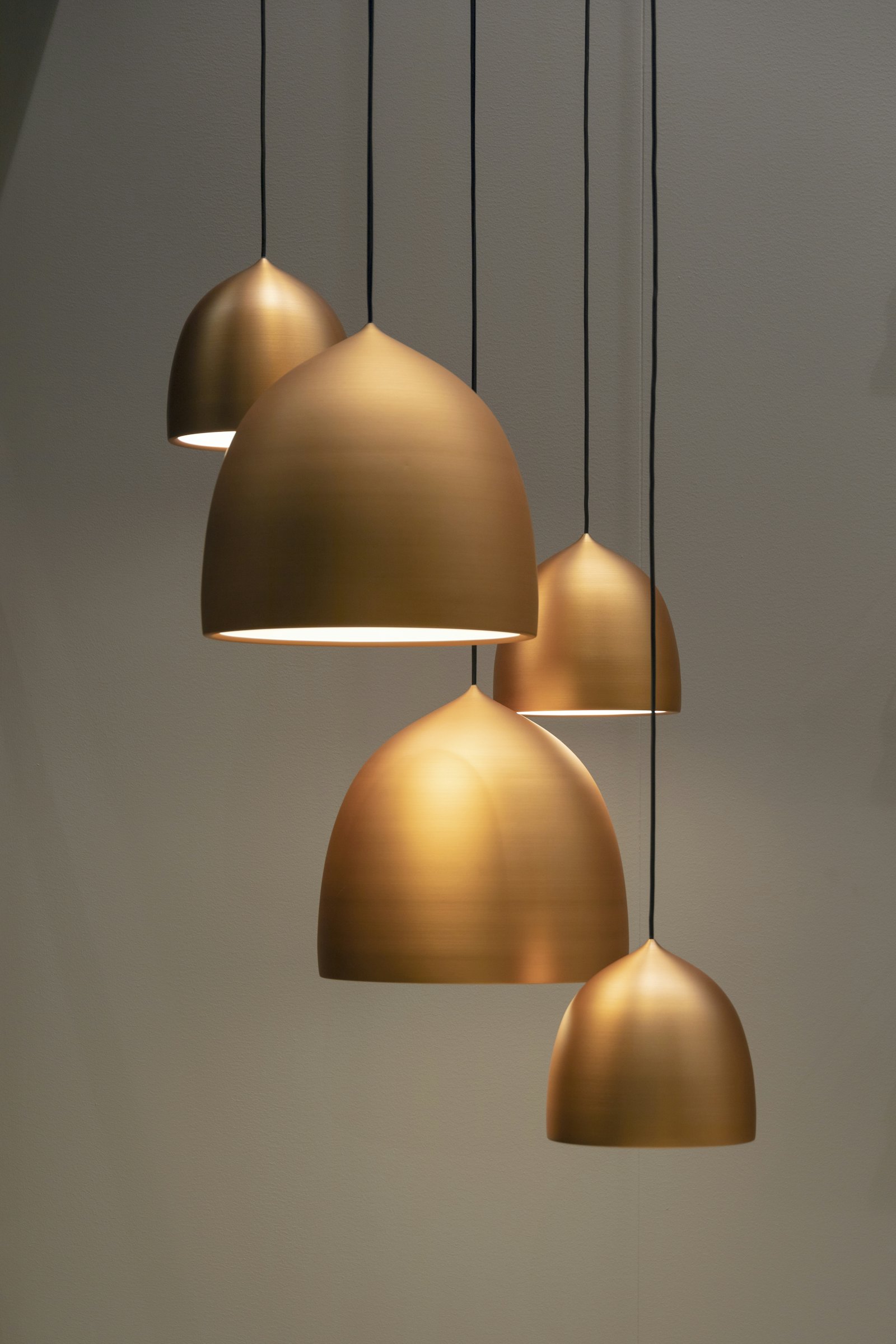
You do not need a museum or a department store stairwell to enjoy the clustered pendant look. Whether you choose glass globes, brass domes or simple ceramic shades, the principles are the same:
- Vary the drop. Hanging pendants at different heights creates movement and depth, and stops a cluster looking like a row of soldiers.
- Use odd numbers. Three, five or seven pendants tend to look more natural than even groupings.
- Think about sightlines. Over a table, keep the lowest pendant high enough that people can see each other across it.
- Choose warm light. Glass and metal shades look their best with warm-toned bulbs, especially in the evening.
- Use a dimmer. A cluster that looks dazzling at dinner can feel too much on a quiet weeknight.
Stairwells and double-height spaces are especially good spots, because the cluster can be seen from above and below, just as the Heal's chandelier was. A tall hallway, too, can be transformed by a vertical cascade of light.
Planning a statement light
Sculptural lighting is an investment, so it is worth planning carefully. Check ceiling heights and the position of your electrics first, and get a qualified electrician involved for anything beyond a simple swap. Consider how the light will look switched off, too: in daylight, a cluster of glass or brass becomes a sculpture in its own right.
If you are remodelling a kitchen at the same time, a cluster over an island pairs well with the open shelving ideas in our open shelving in kitchens feature. And for another dose of design-led glamour from the same summer, see our piece on Eleanor Pritchard textiles.
Looking back
Looking back, autumn 2013 was a high point for sculptural lighting in London, with Bocci glowing in both a museum and a department store at once. Ranges, showrooms and collaborations change over time, so if you are hoping to see Bocci lighting at Heal's today, check what is currently on display before making a special trip. The lesson of that chandelier still holds, though: light can be architecture. For another London retail favourite of ours, read about West Elm in London.
Questions readers ask
What was the Bocci chandelier at Heal's?
It was a chandelier of glass pendants created by Bocci for the historic staircase at Heal's on Tottenham Court Road, unveiled during the London Design Festival in September 2013.
Who designs Bocci lighting?
Bocci is a Vancouver-based design and manufacturing company whose creative director is the designer and architect Omer Arbel.
What is the Bocci 28 series?
The 28 series is Bocci's best-known range of hand-blown glass pendants, each made through repeated heating and cooling so that every piece is slightly different.